


A core system can remain operational even when the security assumptions behind it are no longer appropriate. As businesses adopt cloud services, remote access, APIs and third-party platforms, modernization becomes more than an application decision. It is also a question of whether the system can still be defended in its current operating environment.
Security Assumptions Change Over Time
Many mature enterprise systems were designed for a contained environment, with users inside the corporate network and relatively few external connections. Those boundaries have since expanded to include mobile devices, cloud workloads, partners
and distributed teams. Controls based on network location or implicit internal trust may therefore be less effective than they once were.
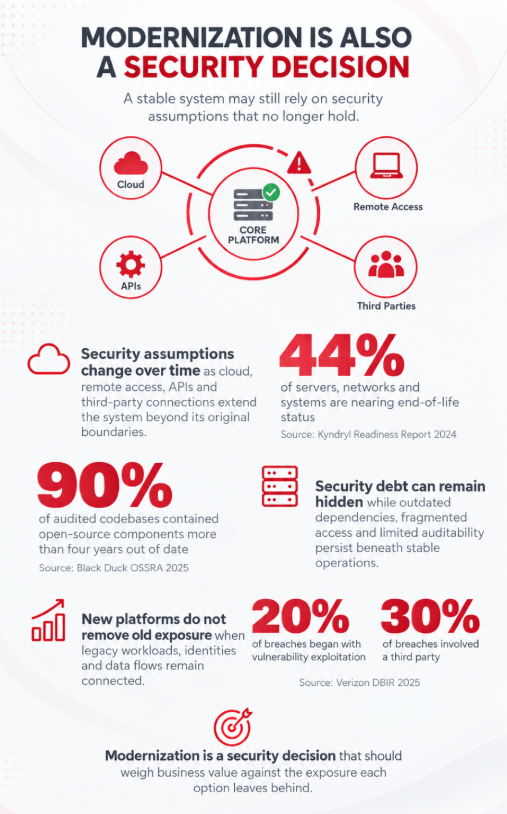
44% of servers, networks and systems are nearing end-of-life status.
Source: 2024 Kyndryl Readiness Report, based on input from 3,200 business and technology leaders across 18 countries.
Security Debt Can Remain Hidden
Functional debt tends to produce visible symptoms such as recurring defects, slower performance or rising maintenance effort. Security debt is harder to detect because outdated controls can continue operating without affecting day-to-day service.
In mature platforms, this debt often appears through older authentication methods, accumulated access exceptions, unsupported dependencies, inconsistent encryption and incomplete audit trails. The gap may only become apparent during an audit, a new integration or a security incident.
New Platforms Do Not Remove Old Exposure
Investing in a new platform does not automatically eliminate the risks associated with the old one. Essential processes, historical data and complex integrations may prevent a legacy system from being retired. The same issue often arises after an acquisition, when multiple platforms must operate together for longer than planned.
This coexistence increases the number of identities, interfaces, data flows and access models the organization must secure. Risk only declines when workloads and controls are migrated, integrated or decommissioned. If delivery capacity cannot keep pace with investment, a temporary transition architecture can become a permanent source of exposure.
Modernization Is a Security Decision
Application and security architecture should be assessed as part of the same modernization decision. The review should consider which business processes remain critical, which dependencies must be retained, how identities and data move across the environment and what security exposure remains under each option.
Not every mature system needs to be replaced. Some controls can be strengthened without major architectural change. Other systems may require modernization, migration or retirement because the underlying security model no longer fits how the business operates.
Rikkeisoft Smart Modernization helps organizations evaluate application, dependency and security constraints within a coordinated roadmap, supporting informed decisions on what to retain, modernize, migrate or retire.
Source: