







A cyber incident can affect more than digital systems. It can interrupt the movement of goods, restrict order handling and disrupt the operations businesses rely on.
Today’s cyber threats can be sophisticated and fast-moving, with consequences for critical business operations. For enterprises, cybersecurity therefore belongs within a broader conversation about business continuity and operational resilience.
Nichirei is a Japanese corporate group whose businesses include processed foods and temperature-controlled logistics. Through its food and logistics operations, the group supports food production, storage and distribution. Its July 2026 cyber incident illustrates how disruption to digital systems can affect these physical business activities.
Our previous article explores why business continuity depends on cyber resilience. This case offers a practical example of how a cyber incident can affect operations and why preparation matters.
What happened at Nichirei?
On 13 July 2026, Nichirei announced a system disruption caused by unauthorised access. The company reported impacts on cold-storage warehouse inbound and outbound activities and frozen-food shipment operations. Its initial announcement stated that the scope of the system disruption was limited to Japan.
In its 15 July update, Nichirei confirmed that its servers had been subject to a cyberattack. It explained that systems had been disconnected on 13 July to prioritise the protection of personal information and customer data. This disconnection affected the disclosed warehouse and shipment activities.
The case demonstrates how measures taken to protect information during an incident can also affect operational availability.
The impact extended beyond IT
Nichirei’s disclosures identified three areas of operational impact:
- Warehouse operations: Cold-storage inbound and outbound activities were affected.
- Food distribution: Frozen-food shipment operations were affected.
- Order handling: Customer and business-partner orders remained subject to some restrictions during partial recovery.
For enterprises, these impacts highlight the relationship between system availability and everyday business activity. Processing an order or coordinating a delivery may depend on several applications, shared records and communication channels.
When an essential system becomes unavailable—or must be disconnected during incident response—the effects can reach employees, customers and partners.
Understanding these dependencies helps organisations connect enterprise cybersecurity with business continuity planning.
Recovery continued beyond restarting operations
On 17 July 2026, Nichirei reported that affected activities had begun resuming in stages. Cold-storage warehouses and food factories were operating partially, with some restrictions on order handling.
Its subsequent September disclosure confirmed that all sites had returned to normal operations on 24 July, following safety checks and necessary measures.
However, operational restoration did not mark the end of the incident’s follow-up.
On 18 September 2026, Nichirei confirmed leakage of personal information stored on some affected servers. The company also described continuing investigation, security improvements and monitoring measures.
Personal information confirmed leaked, as of 18 September 2026
| Affected group | Information involved | Number of records |
| Delivery recipients for delivery services undertaken by Nichirei Group companies | Names, addresses and telephone numbers | 3,308 |
| Officers and employees of business partners | Company names, departments, job titles, names, addresses, telephone numbers and email addresses | 6,849 |
| Nichirei Group employees, including those who left from 2021 onwards; their family members; and job applicants | Names, dates of birth, gender, addresses, telephone numbers, email addresses, employee numbers, salary and bonus information, residency status, personnel information such as department assignments and transfers, and other information | 43,709 |
Notes: Not every record contained all the information listed. Credit-card information was not included. The figures are presented as records rather than a verified count of unique individuals.
Source: Nichirei — Seventh Report, 18 September 2026. Translated and adapted from the Japanese original.
For enterprise leaders, this distinction matters: restoring services and understanding the full consequences of an incident can follow different timelines. Business continuity planning should therefore account for investigation, communication and follow-up after essential operations resume.
Three priorities for enterprise cyber resilience
The following priorities are practical lessons drawn from the disclosed events, rather than conclusions about weaknesses in Nichirei’s security arrangements.
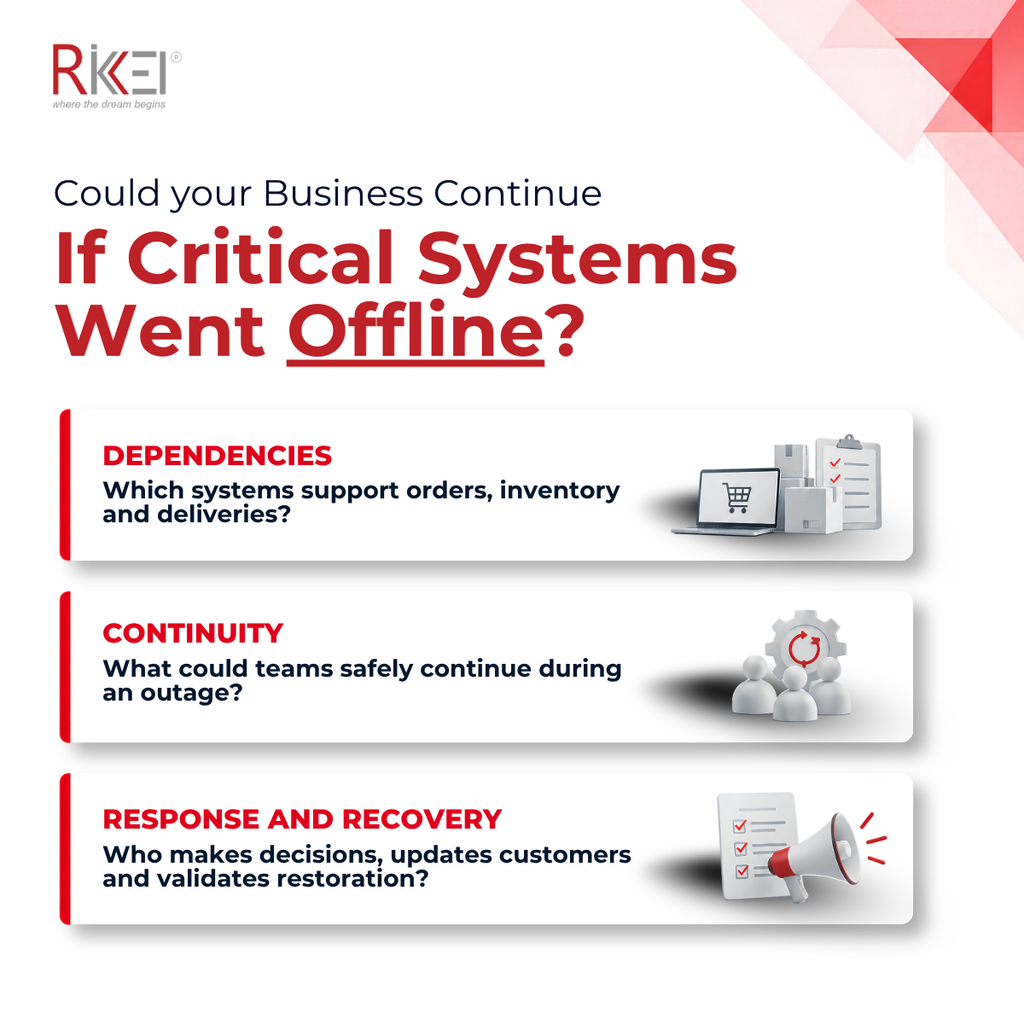
1. Map critical dependencies
Identify the systems, data and external providers supporting essential business activities.
For orders, inventory and deliveries, consider which applications must be available and what happens when one becomes inaccessible. Include shared services and supplier connections in this review.
Useful questions include:
- Which systems support essential business processes?
- Which activities depend on the same application or data source?
- What information would teams need during an outage?
- Which services should be restored first?
This helps teams connect cybersecurity risk management with business priorities and establish a sensible recovery sequence.
2. Prepare and practise response and continuity plans
Determine what teams could safely continue during an outage and which activities would need to pause.
Define decision-making responsibilities, escalation routes and communication arrangements. Employees, customers and partners should receive consistent updates as the situation develops.
Practise realistic scenarios to identify unclear responsibilities or workarounds that depend on unavailable systems. For example, an alternative order-handling process may still require access to customer records or inventory data.
Continuity arrangements should protect information while supporting essential activity. Exercises help teams assess whether those arrangements are workable under pressure.
3. Test recovery of essential services
Test backup restoration and the recovery of critical applications against business requirements.
Confirm that restored services are safe to use, that necessary data is available and that dependent workflows operate correctly. Recovery testing should involve operational teams as well as technology specialists.
A restored application alone may not mean that an entire business process is ready to resume. Teams should also validate the information, connections and procedures required to complete that process.
Include post-restoration activities in the plan, such as continued investigation, monitoring and stakeholder communication.
Make business continuity part of cybersecurity strategy
Nichirei’s disclosed experience provides a concrete example of how a cyber incident can affect physical operations and how follow-up can continue after services resume.
For enterprises, the useful question is:
How would your business continue if critical systems became unavailable?
Answering it requires cooperation across technology, operations and business leadership. Mapping dependencies, practising continuity arrangements and testing recovery capabilities can help organisations prepare for disruption.
As enterprises adopt cloud platforms, modernise applications and connect with external partners, these considerations should remain part of cybersecurity strategy and business decision-making.
How Rikkeisoft supports enterprise cybersecurity
Business continuity requires organisations to understand their exposure, strengthen protection and prepare for incidents.
Rikkeisoft offers cybersecurity services spanning security architecture, penetration testing, threat monitoring, system hardening and digital forensics and incident response. These capabilities support enterprises in identifying exploitable weaknesses, improving detection and investigating and responding to incidents.
Rikkeisoft’s cybersecurity team includes specialists with professional certifications such as OSCP, OSEP, CRTO, CISSP and GCFA, bringing expertise across offensive testing and defensive security.
For enterprises reviewing their readiness, the starting point is to connect security priorities with the systems and processes that keep the business running.
Explore Rikkeisoft’s cybersecurity services to discuss your organisation’s security needs.
Sources
Nichirei official disclosures, published in Japanese. The summaries and table in this article have been translated and adapted into English. The links below lead to the original Japanese disclosures.
Additional company information:
Added illustrations are for visual reference and are not photographs of Nichirei’s facilities or the incident.